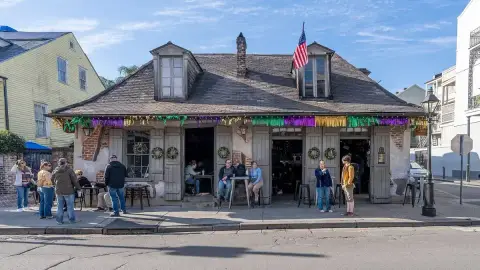
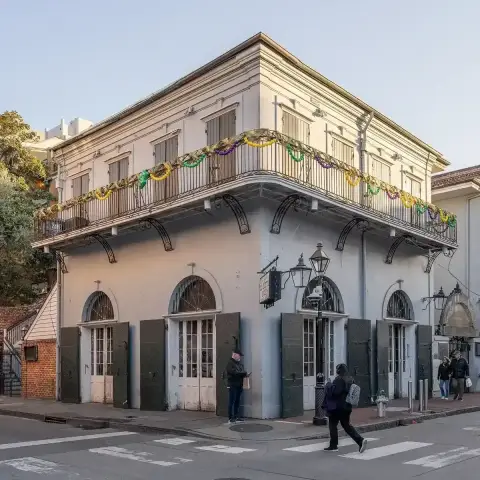
On record from 1869; the building is dated to about 1798.
Grade B · Building dated
By claim, the oldest bar in New Orleans is Lafitte's Blacksmith Shop at the quiet end of Bourbon Street, which dates its building to between 1722 and 1732. The federal survey behind that building's landmark designation dates it instead to between 1772 and 1791, and the bar itself opened in the mid-1940s as Café Lafitte. By evidence the answer is the Old Absinthe House, seven hundred metres down the same street, which was advertising under that name by 1869. Napoleon House, round the corner on Chartres, has the oldest fabric of the three — 1794 and 1814, by the National Park Service — and the youngest trade.
New Orleans keeps its three oldest bar claims inside about 750 m of pavement, and all three carry a story more famous than their paperwork. Jean Lafitte the privateer is said to have run contraband from the Bourbon Street cottage; Lafitte and Andrew Jackson are said to have planned the Battle of New Orleans in an upstairs room at the Old Absinthe House; and Mayor Nicolas Girod is said to have schemed with Lafitte to fetch Napoleon from Saint Helena and house him on the corner of Chartres and St Louis. None of the three has a record behind it, and the third gave its bar a name anyway. What the city has instead is federal paperwork of a quality most places cannot match — National Historic Landmark and National Register forms with a surveyor's name, a visit date and a paragraph on the fabric — and here that paperwork works against the claims rather than for them. It dates the Bourbon Street cottage fifty years later than the bar does. It records a bar and grill on Napoleon House's first floor in July 1975 and nothing earlier. And in two of the three cases the ground floor was a grocery before it was a counter. Put the claims in order and you get 1722, 1806 and 1914; put the records in order and the earliest drinking traced in the French Quarter is an advertisement of 1869.
Two on Bourbon Street, one round the corner
The walk takes about a quarter of an hour at a stroll and the three rooms could hardly be less alike.
Lafitte’s Blacksmith Shop is a low French-colonial cottage at
941 Bourbon, up at the quiet end, and is lit largely by candles once it is dark.
The Old Absinthe House is seven hundred metres down the same street at
number 240, on the corner of Bienville, and is the loud one — one street, two ends of a reputation. Napoleon House is five minutes from the Absinthe House and one
street over, on the corner of Chartres and St Louis, where the Pimm’s Cup is the house drink and the house says it
was the first in America to pour one; it takes no reservations. Two of the three are individually National Historic
Landmarks, both designated in 1970 — Lafitte’s cottage, and Napoleon House under its other name, the Mayor Girod
House. The Old Absinthe House has no entry of its own: it stands inside the Vieux Carré Historic District, which is
a district designation and describes no individual building.
Three claims, two groceries and one advertisement
The Old Absinthe House has the earliest record of drink sold of the three, and it is a modest one: a stuccoed
corner building of 1798 to 1806, which the bar itself dates to 1806; a ground floor that began as a grocery; a bar
there by roughly the 1830s; and an advertisement under the Absinthe House name in 1869. What made it famous came
after that — the absinthe frappé poured by the bartender Cayetano Ferrer in the 1870s. The Jackson and Lafitte
meeting upstairs went as far as a courtroom in 1951, when a rival house on Chartres Street sued over the right to
display the plaque, and the court treated the meeting as legend. Napoleon House is the reverse case: the
best-documented building of the three and the latest trade. The National Park Service dates its two-storey section
to 1794, built by Claude François Girod, and the three-storey corner to 1814, built by his brother Nicolas during
his first term as mayor; the bar’s own account says 1797. The earliest dated record of drinking there anybody has
opened is the National Register nomination of 15 July 1975, which notes a bar and grill on the first floor and
apartments above — on a form that gives the address as 504 Chartres, where everything since has said 500.
The building the federal survey dates half a century later
Lafitte’s is the one visitors are sent to, and the gap between its claim and its record is the widest of the three.
The cottage is a rare survival of briquette-entre-poteaux work — soft brick between cypress uprights, plastered
outside against the rain — nearly square, four equal rooms originally, with a flared hipped roof and pedimented
dormers. The bar dates it 1722 to 1732 and the 1968 survey dates it 1772 to 1791. Under present use, in 1968, that
survey recorded one word: bar. It had been one since the mid-1940s, when Tom Caplinger opened Café Lafitte in it,
and the candlelight is a large part of why the legend survives. None of that makes the house young; it makes the
house older than the business inside it, which is the commonest shape of claim on this site and is explained in
how to tell how old a pub is. The national argument these three take part
in is set out in what is the oldest bar in America, the wider list is at
the oldest bars in the USA, and the grading is in the methodology.
The 1722-32 is the bar's own: its about page, archived in December 2023, says the building was put up between 1722 and 1732 by Nicolas Touze and is reputed to be the oldest structure used as a bar in the United States. The present site loads nothing a reader can check. National Historic Landmark documentation dates the briquette-entre-poteaux building to the 1770s, and the Jean Lafitte smuggling story is
Claims 1722; no early record found; building c.1770.
Nothing states 1807, the year this row used to claim. The bar's own page, on its operator's site, says the building was built in 1806 and calls the house one of the city's prominent historical landmarks; New Orleans Historical puts the stuccoed corner building at about 1806 and among the oldest structures in New Orleans. Neither dates drink. The ground floor began as a grocery, Wikipedia has a bar there by about the
Claims 1806; first recorded 1869; building c.1798.
The building is far older than the bar, and the bar's own two best sources disagree about when it opened. The front of napoleonhouse.com says the house has been owned and operated by the Impastato family since 1914 and by Ralph Brennan since May 2015, and its history page says that in 1914 the family bought the property and Joseph "Uncle Joe" Impastato turned it into the restaurant and bar. The National Trust for
Claims 1914; first recorded 1975; building c.1794.
On records rather than claims it is the Old Absinthe House at Bourbon and Bienville, advertising under that name by 1869. Lafitte's Blacksmith Shop carries the louder claim, 1722, and opened as a bar in the mid-1940s. Napoleon House has a building dated to 1794 and the latest counter of the three.
Is the oldest bar in Louisiana in New Orleans?
On our research so far, yes: every Louisiana bar this site holds stands in the French Quarter, which is why the state has no page of its own here and this one answers for both. That is a gap in our coverage rather than a verdict on Baton Rouge or the river parishes.
Is Lafitte's Blacksmith Shop really from 1722?
Its own page gives 1722 to 1732 for the building. The National Park Service survey form behind the 1970 landmark designation, recorded by the historian Charles W. Snell after a visit in March 1968, dates the house to between 1772 and 1791 and notes its tile roof as a covering general in the city only after the fire of 1794.
Did Jean Lafitte work as a blacksmith there?
Nothing published shows it. The federal form repeats the story as tradition and credits the building to Jean and Pierre Lafitte without supporting either, and the Historic American Buildings Survey recorded the place in 1934 as a cottage at 941 Bourbon Street rather than as Lafitte's anything.
Why is Napoleon House out of the ranking?
Because its 1914 dates a tenancy. The bar says the Impastato family has owned and operated the house since that year; the National Trust for Historic Preservation has Joseph Impastato renting in 1914, buying in 1920, and the ground floor a grocery first and a bar later, with no year given for the change.