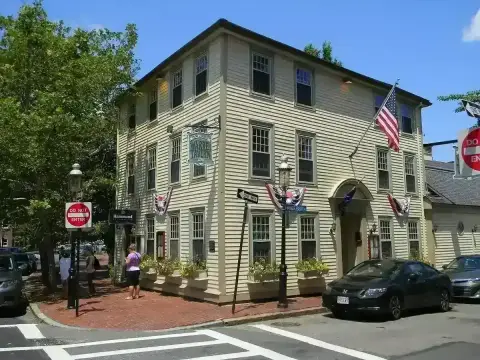
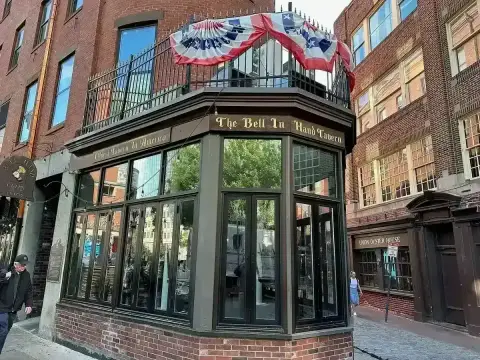
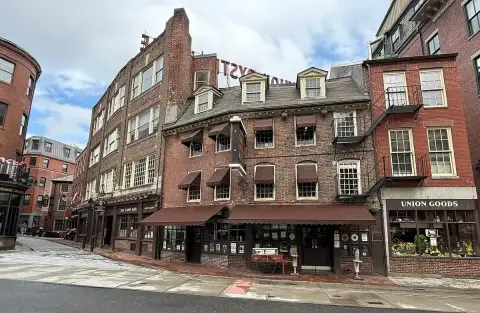
By claim and by record the earliest date in Boston on this list belongs to the same house: Warren Tavern in Charlestown, built about 1780 among the first buildings raised after the British burned the town, with King Solomon's Lodge meeting in it in 1783 and 1784 under a charter Paul Revere signed. The Bell in Hand claims 1795 and the title of America's oldest tavern, on a tradition and after at least three changes of premises. The Union Oyster House has the oldest fabric, of about 1716, and says itself that what opened in 1826 was a house for food.
Boston's old drinking rooms survive in two places because most of the town they belonged to does not. Two of the three here stand on Union Street in the Blackstone Block, where the colonial street plan survives; the third is across the water in Charlestown, on a corner built up immediately after the British burned that town in 1775. All three trade a short walk from the Freedom Trail, which matters to how their dates are written as much as to their takings: "America's Oldest Tavern: First Pour 1795" is how the Bell in Hand puts it, which is a house's own wording and not a claim assembled from records. What makes Boston gradeable is that the records are open anyway, and from two directions the houses do not control. The National Historic Landmark nomination that listed the Union Oyster House in May 2003 sets out its sequence year by year — a dwelling in the early 1700s, a specialty store from 1742, an oyster house from 7 October 1826 — which is more, and better sourced, than any of these businesses publishes about itself. And the city licensing board's returns are city open data, so an active all-alcohol licence can be read off a public dataset rather than inferred from a menu. The gap in Boston is not evidence. It is continuity: each of the three has a break, a move or a change of trade in the middle of its story.
A Charlestown corner and two houses on Union Street
Warren Tavern is the building worth crossing the river for: weatherboarded, low-beamed,
on a Charlestown corner, named for Dr Joseph Warren who was killed at Bunker Hill, and used by Paul Revere’s Masonic
lodge within three years of going up. Washington called in 1789. It was nearly lost around 1970 and the Boston
Redevelopment Authority restored it in 1971. The Union Oyster House holds the
oldest fabric on this page and the best-documented interior: a semicircular oak counter over soapstone, with cast iron
stall fittings, standing in the position it was given in the 1820s, which the landmark nomination calls — with the
booths beside it — the only known survivors of their kind in the United States.
The Bell in Hand is the loudest and the least documented, named for the hand bell its founder carried as Boston’s town crier, and now a
room for bands and late nights. Both Union Street houses sit in the Blackstone Block, close enough that our own
coordinate check queries them every time it runs, and since nobody has settled whether that is one building or a
copied pin, nothing on this page turns on how far apart they stand.
Three breaks in three stories
Boston is where this site’s distinction between an old house and an unbroken trade does most of its work, because
every one of these three has a gap and each gap is a different shape. Warren Tavern stopped being a tavern around 1813
and spent a century and a half as a bakery, a club and a warehouse before the restoration that brought it back in
1972: the frame is genuine and the trade is not continuous. The Bell in Hand has moved at least three times to reach
Union Street and closed during Prohibition, so its 1795 belongs to a business rather than to an address — and the 1795
itself rests on tradition, as Wikipedia notes, with the town crier’s founding unsupported by a record. The Union
Oyster House is the opposite case: it has fed people at the same counter without a break since 1826, and what opened
in 1826 was not a drinking house. Drink is in its record from an 1854 advertisement pricing the Atwoods’ liquors by
the gallon, Daniel Webster is reputed to have taken a tumbler of brandy and water with each half dozen oysters in the
1840s and 1850s, and the bar room now trading opened in August 1983. Three good houses, three ways to fail a test of
continuity. The test itself is described in
how historians date an old pub, and the national argument these claims feed
into is in what is the oldest bar in America.
Reading a city’s own paperwork
The pleasure of researching Boston is that the public record is more forthcoming than the marketing. The Bell in
Hand’s website refuses readers it does not recognise, so its own founding claim had to be cited from a copy taken in
2019; meanwhile the National Park Service will hand anybody the full nomination text for a National Historic Landmark,
and the city will hand anybody its licensing dataset. That combination is why one house on this page carries a grade A
and the other two do not, and why the grades here rest on a Masonic lodge’s meetings, a dated advertisement and a
federal nomination rather than on anything printed on a sign outside.
Where Boston sits in the wider list
Three houses is thin for a port this old, and the gap is ours: the North End and Beacon Hill are unworked here, and
so is the question of which Boston rooms never got their licences back after Prohibition. The state picture,
including a Post Road inn licensed in 1716, is at
the oldest bars in Massachusetts; the country’s is at
the oldest bars in the USA. For how a claim is weighed against a record on this site, read the
methodology.
Eliphelet Newell built the tavern soon after the British burned Charlestown, and King Solomon's Lodge, whose charter Paul Revere signed, met here in 1783-84. Tavern use lapsed about 1813 and the building served as a bakery, a club and a warehouse; the Boston Redevelopment Authority restored it in 1971 and it reopened as a tavern in 1972, so the trade is not continuous even though the house is. The tavern itself
Claims 1780; first recorded 1783; building c.1780.
The 1795 is the tavern's own, printed at the head of its website as 'America's Oldest Tavern: First Pour 1795' and cited here from a 2019 copy because the live site refuses readers it does not recognise. Wikipedia notes the foundation by town crier Jimmy Wilson rests on tradition. The business has moved several times to reach 45 Union Street and it stopped trading during Prohibition, so 'oldest continuously
The 1826 is documented and is not a drinking house, which is why the grade here is C and the ranking leaves the house out. The nomination that made this a National Historic Landmark on 27 May 2003 sets out the sequence plainly: a dwelling in the early 1700s, a specialty store from 1742, and a restaurant from 1826, when Hawes Atwood opened his oyster house on the ground floor on 7 October. The house's own wording is
Claims 1826; first recorded 1854; building c.1716.
The photographs above are other people's work, used under open licences. Every photographer, licence and source page is named in the image credits.
Common questions
Which is the oldest bar in Boston?
On the evidence, Warren Tavern in Charlestown, built about 1780 and documented from 1783 by the Masonic lodge that met in it. The qualification is large: tavern use there lapsed around 1813 and the building was a bakery, a club and a warehouse until it was restored and reopened as a tavern in 1972.
Why is the Union Oyster House out of the ranking?
Because its 1826 dates a house for food, which the business says itself and the landmark nomination confirms. Drink comes into the record in an 1854 advertisement offering the Atwoods' liquors by the gallon — a price for carrying it away — and the bar room trading today, the Union Bar, opened in August 1983.
What is the Blackstone Block?
A surviving piece of old Boston around Union Street. The National Historic Landmark nomination calls the central house of the Union Oyster House the earliest building in the block and a rare survival of Georgian Boston, dating it to about 1716, with a south range added in 1851 and a north one in 1916.
How do you know a drink is served without a meal?
In Boston it can be checked. The city publishes its liquor licences as open data, and the Union Oyster House holds an active all-alcohol licence with none of the conditions tying a drink to a meal that the board attaches to some restaurants. Warren Tavern says in its own words that you may sit at the bar for a pint.