
The claim
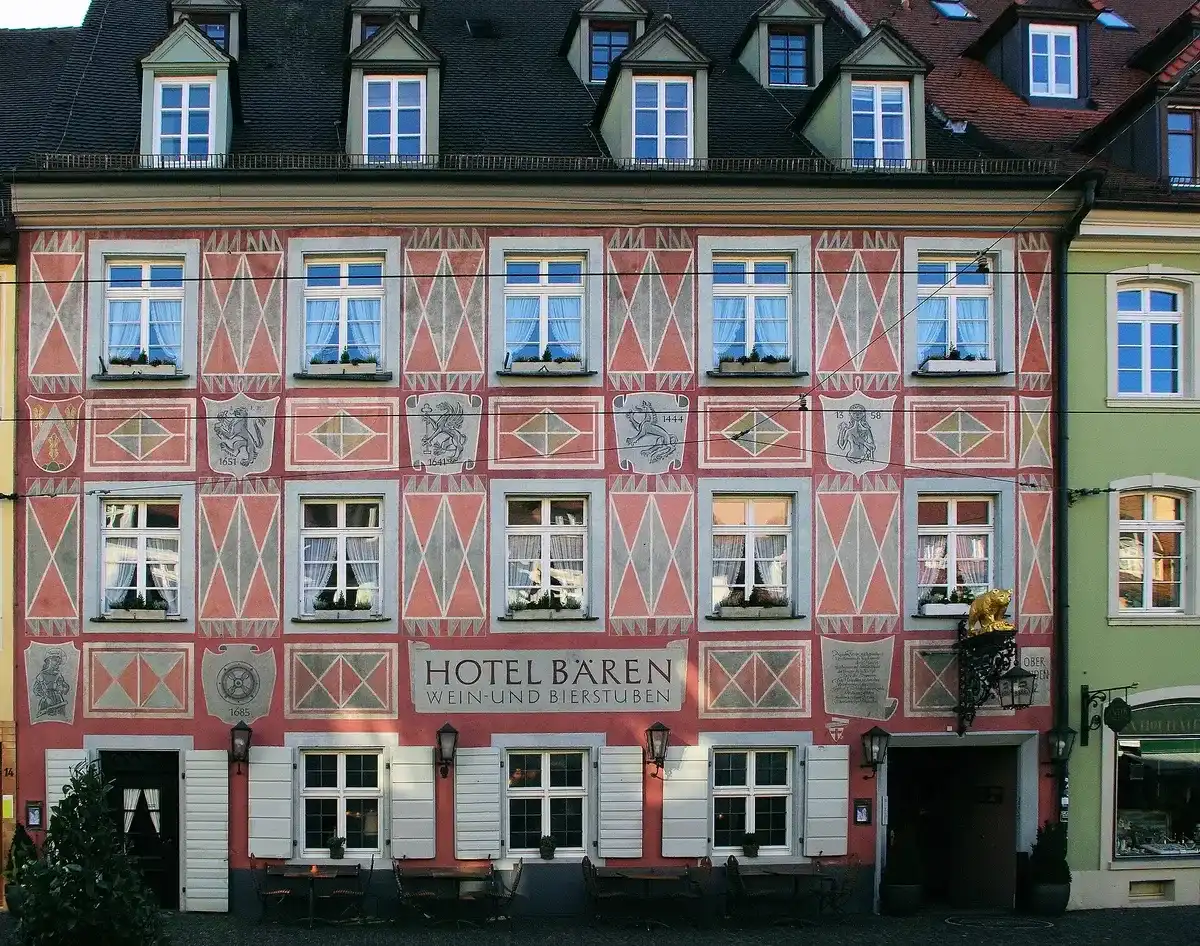
At Oberlinden, in the last few metres of Freiburg’s old town before the Schwabentor, a baroque front with a bear over the door carries the year 1120. Zum Roten Bären calls itself the oldest inn in Germany, and 1120 is the year the dukes of Zähringen founded the city around it. Freiburg’s own tourist service repeats the claim; so does the regional press.
Germany is an awkward country in which to make that claim, because at least two other houses make it as well, and because the German record for a drinking house is rarely a licence. Brewing rights, property registers, court books and monastic accounts are what survive, and each of them dates a slightly different thing. So the argument here is not the usual one about whether a legend is true. It is about which of three documented houses is documented earliest, and about what the Bären’s own number refers to.
What the records show
The Bären’s paperwork is good, and it is later than the sign.
A Bienger — the family who held the house for close to a century — appears in a land record of the Adelhausen convent in 1311. The document names a man and a property; it does not call him an innkeeper. That step comes on 13 March 1387, in a court paper that describes Hanmann Bienger as Würt ze dem roten Bern, the landlord at the Red Bear. A named man, a named house, and his trade, all in one dated legal instrument: on this site that is the shape of evidence that earns a grade rather than a shrug, and it is why the Bären grades B and not C.
The Biengers held the house until about 1406. The Bären counts more than fifty landlords since, and was for a long stretch the guild house of Freiburg’s shoemakers, whose window is in the Minster. None of that reaches 1120, and none of it needs to: a court calling a man the landlord at the Red Bear in 1387 tells you the house was already known by that sign, which means the trade was older than the paper. How much older is exactly what nobody can say.
The building, dated
The interesting fabric here is below the floor, and it is genuinely of the claimed date.
The foundations of the house and its three-storey cellar — arcades and pillars, on three levels — belong to the manor house of the Zähringer court that stood on this ground before Freiburg was laid out. German Wikipedia and the city’s tourist service agree on that, and the cellar can be looked at without ordering anything: there is a glass panel set into the floor of the entrance. A Gothic timber column down there is said to have been cut in 1263, which would make it older than the oldest beam in the Minster. In January 2012 the Badische Zeitung reported that its rotted foot was being cut away and replaced with a stone plinth.
Above ground, almost nothing is medieval. The two encyclopedias disagree about why. The English one has the present baroque house finished in 1718 for the landlord Andreas Pflug after French soldiers damaged the older building; the German one has the Romanesque and Gothic arcaded house pulled down after the French razed Freiburg’s fortifications in 1744, with the Strohmeyer family, who then held it, compensated and rebuilding from the ground. Either way the front a visitor photographs is eighteenth-century, and the case for 1120 rests on the cellar.
That is an unusual arrangement and worth noticing. Most of the houses on this site have a building older than their earliest document. Here the document of 1387 and the cellar of the 1120s are both real, and the four hundred years between them are filled by a building that no longer exists.
What 1120 actually dates
1120 is a city’s founding, not a house’s. It is the year the Zähringer dukes gave Freiburg its market and its plan, and a great many Freiburg institutions date themselves from it for the same reason that a great many English pubs date themselves from a battle. What sits under the Bären from that period is a nobleman’s manor: a court house, with a very good cellar, belonging to the people who owned the ground.
A manor’s cellar is not a public drinking house. Somebody standing in the Oberlinden in 1120 could not have walked in off the street and bought a beer, because there was not yet a street in the sense the word now has, and the building was somebody’s residence. This is the same distinction that keeps St Peter’s in Salzburg out of our ranking with a date of AD 803 against it: a monastery cellar and a manorial cellar are both cellars, and neither is a bar.
The difference — and it matters — is that the Bären does not stop at 1120. It publishes the 1387 court paper too, on its own history pages, and it is straightforward about the cellar being the old part. A house that prints the weaker date in large letters and the stronger one underneath is doing better than most.
The three houses that claim the title
Set the three claimants side by side and the picture is clearer than any of them alone.
Gasthaus Zum Riesen at Miltenberg on the Main also calls itself Germany’s oldest inn, and dates itself to 1158 on the strength of a visit by Frederick Barbarossa. Its own history page is honest about the trail: the 1158 comes from an 1865 pamphlet by a Dr Ph. Madler, who reported the Hof zum Riesen as known from documents by the middle of the twelfth century — and the documents Madler worked from no longer survive. What does survive is the Miltenberg court book of 1411, naming Conrad Trestram as the Riesen-Wirt. The standing frame is dendro-dated to 1590, with an adjoining range to 1481 or 1482.
The Herberge zum Löwen at Seelbach-Schönberg in the Black Forest is the third, first documented in 1231 and describing itself as one of Germany’s oldest inns. German Wikipedia records it as currently closed, which settles it for our purposes: this site ranks houses you can walk into.
So on the documents, the order is the Bären in 1387, the Riesen in 1411, and the Löwen’s 1231 mention attached to a house that is not pouring. On the signs, the order is the Bären in 1120, the Riesen in 1158 and the Löwen in 1231. The two orders happen to disagree about the middle, and agree about the top.
| Pub | Claims | First record | Building | Grade |
|---|---|---|---|---|
| Zum Roten BärenFreiburg im Breisgau | 1120 | 1387 | The foundations and the three-storey cellar are traced to about 1120 and before, as part of the Zähringer manor house; the Gothic timber column in that cellar carries the date 1263, and the Badische Zeitung reported in January 2012 that its rotted foot was being replaced with a stone plinth; the baroque building above is 18th-century | Grade B |
| Gasthaus Zum RiesenMiltenberg | 1158 | 1411 | 1590 (Renaissance timber frame by the carpenter Jakob Stoer, dendro-dated; Gothic remains of the earlier inn inside it, and an adjoining south-west range dendro-dated 1481/82) | Grade C |
So how old is the Bären?
Older than its rivals on paper, and younger than its own sign by two and a half centuries.
The cellar under the house is of the 1120s and was a nobleman’s, not a publican’s. The earliest record of anybody selling a drink here is the court paper of 13 March 1387, which is the oldest such record we have traced for any German house, and better than anything either rival can produce. The building between the cellar and the roof is eighteenth-century. All three of those statements are documented, and a reader who wants one number should take 1387, because that is the year somebody wrote down that this was an inn.
Whether that makes it the oldest inn in Germany depends entirely on which of the four things — ground, cellar, record, or continuous trade — the phrase is meant to measure, which is why our methodology grades the record and prints the claim beside it rather than awarding a title. The rest of the country is at the oldest pubs in Germany.
Sources
- roter-baeren.de/historie/
- roter-baeren.de/restaurant/
- de.wikipedia.org/wiki/Zum_roten_B%C3%A4ren
- en.wikipedia.org/wiki/Zum_Roten_B%C3%A4ren
- visit.freiburg.de/en/zum-roten-baeren
- badische-zeitung.de/freiburg/roter-baeren-holzsaeule-von-1263-wird-saniert--54929850.html
- de.wikipedia.org/wiki/Herberge_zum_L%C3%B6wen
- riesen-miltenberg.de/geschichtedesriesen/
Found something wrong?Suggest a correction