
The claim
AD 793 is a real date in English history: it is the year the Anglo-Saxon Chronicle records the sack of Lindisfarne. It is also the year painted on the sign of a low octagonal building beside the River Ver, in the water meadows below St Albans Abbey, which for most of the last century has been the best-known claimant to the title of England’s oldest pub.
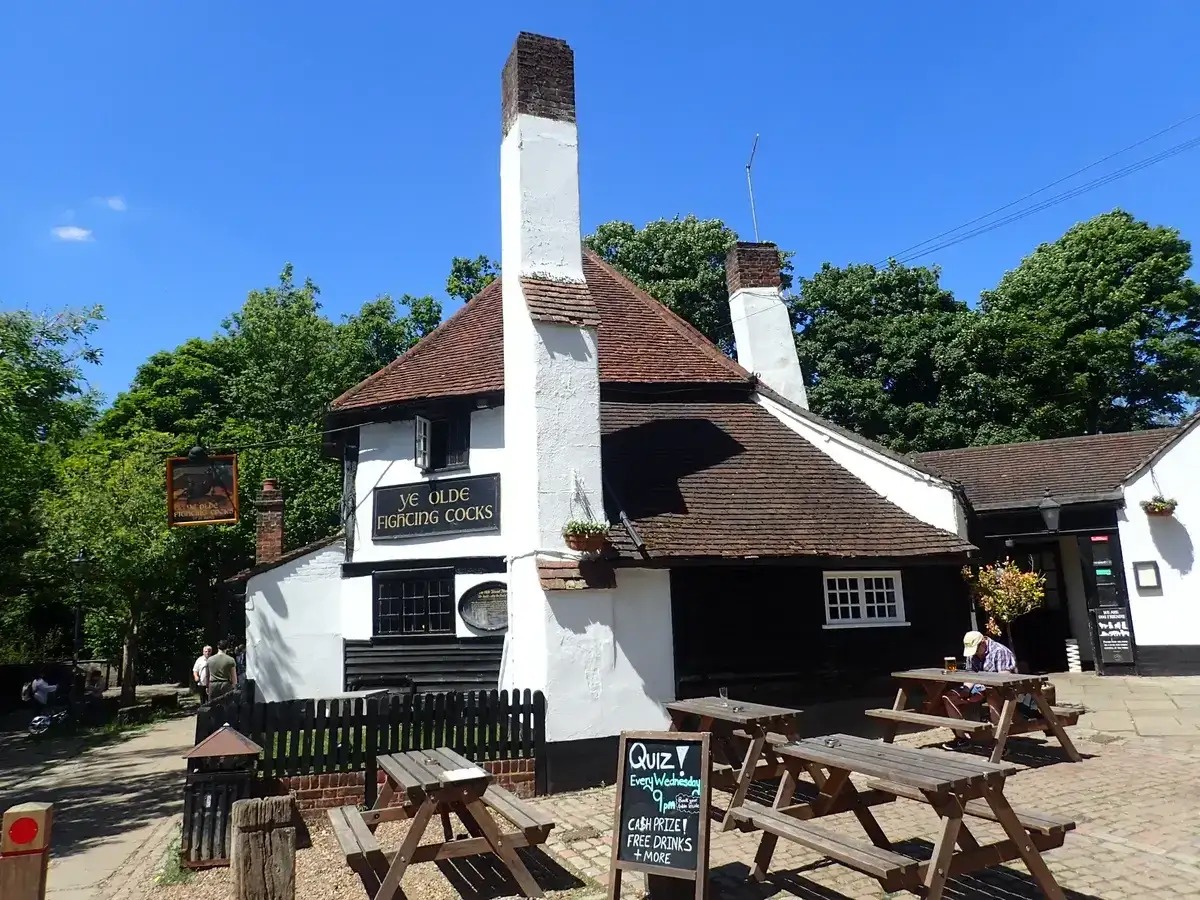
Ye Olde Fighting Cocks wears the claim well. The building is squat, odd-shaped and unmistakably old; inside are beams you duck under, alcoves that seat four at a squeeze, and a bread oven beside one of the fireplaces. Set against the abbey on the hill above, it looks like the oldest pub in England, which is a large part of why the story has lasted.
Where 793 came from
A postcard. Historic England, reviewing the country’s oldest-pub claims, found that the 793 date is first mentioned on an early-twentieth-century postcard and is not based on any historic record. The usual justification offered locally — that the foundations date from the eighth century — has never been supported by an excavation report or a published survey.
The claim did once have an adjudicator. Guinness World Records listed the Fighting Cocks as England’s oldest pub for years, and the pub understandably made the most of it. In 2000 the record was withdrawn from consideration on the grounds that it was impossible to verify. Guinness no longer maintains a category of that kind at all, so no pub’s claim to the title has had an adjudicator behind it for a quarter of a century.
What the records show
The building’s real story is stranger and better than 793, and it begins with pigeons rather than beer.
| What | Ye Olde Fighting Cocks |
|---|---|
| Claims | AD 793 |
| Original structure | abbey dovecote, dated to about 1400 |
| Re-erected as a house | by 1622, as the Round House |
| First record as an alehouse | 1756, as the Three Pigeons |
| Present name | in use by about 1800–1807 |
| Listed | Grade II, listed 8 May 1950 |
| Our grade | C — tradition |
The octagon is not an eccentric pub plan. It is the plan of a dovecote — a monastic pigeon house, in which birds were kept for meat and eggs — and Historic England dates the structure to around 1400. That accounts for the shape, the thick walls and the absence of anything resembling an original bar.
Then comes the one genuinely dated document in the story. Legal papers record that a Thomas Preston “bought an old pigeon house and pulled the same down and erected it… and made thereof a tenement which is now called the Round House”. The papers place this by 1622. So the building you drink in is a medieval dovecote taken down and rebuilt as a dwelling in the years around 1600 — which is why Historic England describes its appearance as sixteenth-century, and why various accounts quote dates as different as 1400, 1485 and 1622 for “the building”. They are all describing different stages of the same much-moved structure.
There is no record of the Round House being licensed to sell drink. The first firm evidence of an alehouse here is 1756, when it traded as the Three Pigeons — a name that quietly admits what the building had been. It was serving beer as the Fighting Cocks by the early 1800s, from the sport that gave it the name, and which may well have taken place in what is now the main bar. The “Ye Olde” was a later addition, part of the same Victorian and Edwardian appetite for manufactured antiquity that produced the postcard.
So how old is it?
Old, on any honest measure. A structure of about 1400, re-erected around 1600, licensed by 1756 and pouring continuously enough since to be a fixture of the city: that is roughly 270 years as a drinking house, in a building that has stood in one form or another for six centuries. Very few pubs in England can match it, and the dovecote story is more unusual than any founding date.
What it is not is a pub from 793, or from any century before the eighteenth. On the evidence, the oldest documented purpose-built inn still trading in England is the George at Norton St Philip in Somerset, whose upper timbers have been tree-ring dated to 1430–32 and which was built as an inn by the Carthusians of Hinton Priory. Historic England’s own conclusion is that around a dozen medieval purpose-built inns survive in use, the earliest of the late fourteenth and fifteenth centuries. St Albans is not among them, and neither are the other headline claimants: the Bingley Arms near Leeds, which says 953 and has a 1738 datestone, or Ye Olde Trip to Jerusalem, which says 1189 and first appears in 1751.
The Fighting Cocks came close to being a lost pub rather than a disputed one. It went into administration in February 2022, at the end of the pandemic trading years, and reopened weeks later when its former manager and head chef joined a new team taking on the lease. A pub that has been standing since the fifteenth century and serving since the eighteenth almost went under in the twenty-first, which puts the argument about 793 into some perspective.
See how we grade claims like this in our methodology, where it sits in the top 100 oldest pubs, and the rest of the field on our page for England’s oldest pubs.
Sources
Found something wrong?Suggest a correction