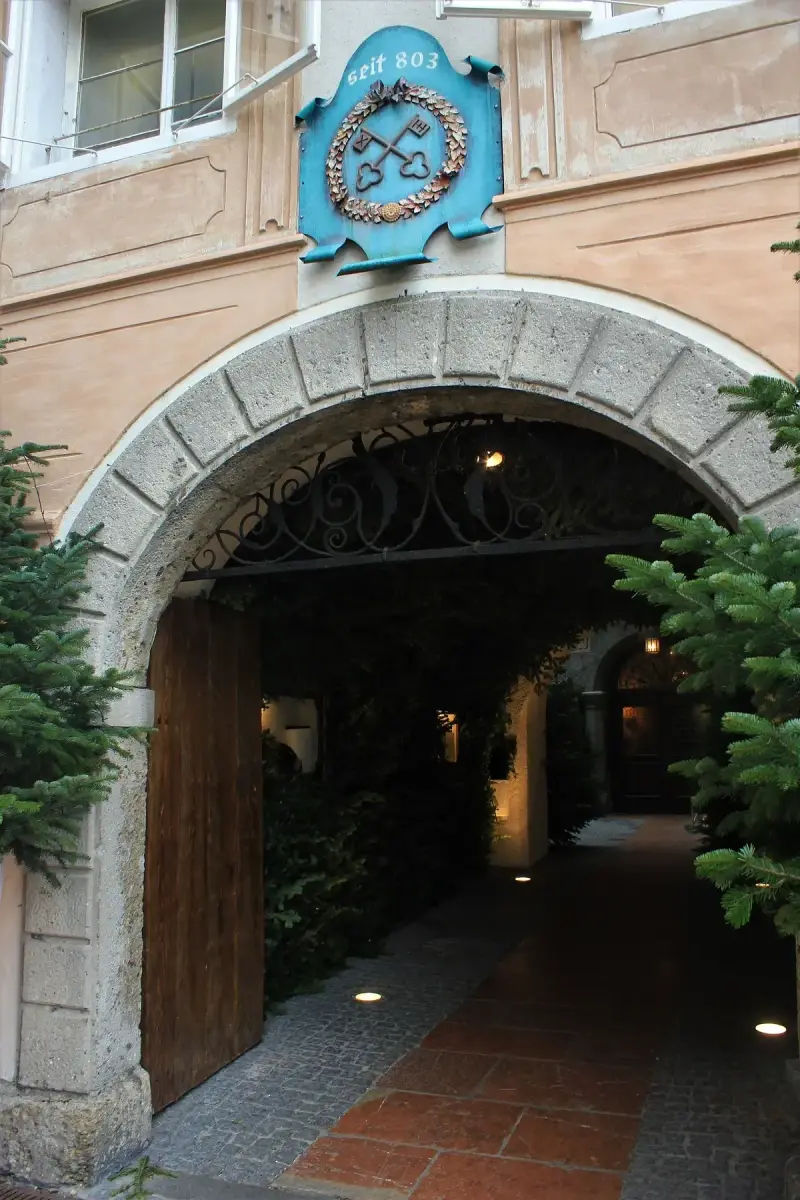

The claim
In the courtyard of the Benedictine abbey of St Peter, under the cliff of the Mönchsberg in the middle of Salzburg, a restaurant sets tables in rooms among the oldest walls in the city. St Peter Stiftskulinarium dates itself to AD 803 and describes itself as the oldest restaurant in Central Europe. It is the boldest date on this site by a margin of nearly a century and a half: nothing else here claims a year in three figures except the Old Ferry Boat Inn at Holywell and Ye Olde Fighting Cocks in St Albans, and both of those are arguments about English legend rather than about a surviving document.
This one is not a legend. There is a document, it is dated, it is in print, and anybody can look it up. The question worth asking is a different one, and it is the question this site was built to ask: what does the document actually say, and does it describe a place where a member of the public could buy a drink?
What the poem actually is
The source is a verse by Alcuin of York, the Northumbrian scholar in Charlemagne’s circle, praising the cellar of St Peter’s abbey and the beer kept in it. It survives among his collected poems, and the reference the abbey and the encyclopedias both give is precise: Carmen CXI in Alcuini Carmina, edited by Ernst Dümmler for the Monumenta Germaniae Historica and published in Berlin in 1881 as the first volume of the Poetae Latini aevi Carolini. That is a scholarly edition of a Carolingian text, not a brochure, and it is a far better footing than most of the pre-1200 claims on this site have.
Two things follow from it, and they pull in opposite directions.
The first is that the cellar is not in doubt. A monastery that Alcuin’s circle knew well enough to write verses about had a cellar, kept beer in it, and thought the beer good. St Peter’s is among the oldest monastic foundations north of the Alps, its abbots are a continuous line, and there is no reason to suppose the room being praised is a different room from the one the restaurant now occupies part of.
The second is that Alcuin was not sitting in it. From 796 until his death in 804 he was abbot of St Martin’s at Tours, several weeks’ travel away, and his documented connection with Salzburg is a correspondence — a long and affectionate one — with Arn, the city’s bishop and from 798 its first archbishop. We have traced nothing that places Alcuin in the cellar he describes. A poem written at a distance, in praise of a friend’s house, is a normal Carolingian courtesy and an unusual thing to build a trading date on.
The building, dated
What a visitor stands in is a good deal younger than either the poem or the walls around it. The abbey’s own chronology dates the rock cellars cut into the Mönchsberg: Abbot Wolfgang Walcher had one driven into the cliff in 1517, and Abbot Chillian Pitricher a second in 1527. The baroque hall where the Mozart dinner concerts have run since 1996 was built in 1903, during the renovations Abbot Willibald Hauthaler began around the turn of the century. Michael Haydn lived on the floor above from 1763, which is a genuine and checkable piece of the house’s history and is roughly a millennium later than its founding date.
The first lease in the house’s history — the first time the abbey let somebody else run it as a business — was signed in 1992. The name changed from Stiftskeller to Stiftskulinarium in 2017. Neither fact damages the claim, but both are worth setting beside it, because the picture usually drawn is of one unbroken business, and what the abbey describes is a monastic cellar that became a tavern, became a restaurant, and was let out four years before the euro was agreed.
When outsiders started drinking here
The most useful evidence against AD 803 comes from the abbey itself, and it is offered without argument, as chronology. Wine was carried out of Austria under ducal protection in the thirteenth century. Carters and craftsmen working for the monastery were paid partly in a wine penny or a house draught, so that, in the house’s own phrase, little by little a Buschenschank — a grower’s tap — became a Gaststätte. The year the chronology marks for outside custom is 1720, when it says nobility, townspeople and clergy came in. And the right to sell beer at all was bought only in 1803: before that the fathers could pour nothing but wine of their own growing.
Read those three sentences in order and they describe the arrival of a public drinking house, slowly, between the thirteenth century and the eighteenth. That is why this house carries AD 803 as its claim on our pages, 1720 as its earliest record, and no place in the top 100 oldest pubs at all. A monastery’s wine store at the head of a ranking of drinking houses would misdescribe every house below it. The Hofbräuhaus in Munich is kept out of the same list for the same reason, and its gap is two and a half centuries rather than nine.
What the Salzburg newspapers show
Austria has one of the best newspaper archives in Europe, ANNO, run by the Austrian National Library, and it can be searched by anybody. We searched it on 12 September 2026 for the cellar under every name it has used.
The earliest mention of the name Stiftskeller St. Peter is in the Salzburger Chronik für Stadt und Land of 22 February 1867, where the members of a society who had been meeting from nine in the morning until one in the afternoon went on to the Stiftskeller for a plain meal. The earliest mention of the cellar under any name is four years earlier, in the Salzburger Zeitung of 9 July 1863, which describes an arrangement made in the St Peter cellar rooms. Neither is a founding record; both are ordinary notices of the kind a working public house generates constantly.
What is striking is where they sit. The printed record of outsiders eating and drinking here begins in the 1860s — a century and a half after the year the abbey’s own chronology marks for public custom, and a full millennium after the poem. A house of this fame leaving no earlier trace in the Salzburg press is not proof of anything on its own, since the press itself is young. It is a useful corrective to the shape of the story, which is always told as continuity.
So how old is the Stiftskulinarium?
Older than almost anything, and not in the way the number suggests.
The cellar is early medieval and the poem about it is genuine, which puts this house in a class of its own among the pre-1000 claims on this site: everywhere else the document is missing and the argument is about tradition. Here the document exists, it has been edited to a modern standard, and it says what it is quoted as saying. Our grade is C all the same, because a grade on this site answers one question — was this a public drinking house at the date it claims — and the poem answers a different one.
If you want the year that marks a room you could have bought a drink in, the abbey has already supplied it: 1720 for outside custom and 1803 for beer. If you want the year the beer in this cellar was first written down, it is around 803 and the writer was English. Both are true, and a page that prints only one of them is not telling the reader what the record shows. The methodology sets out why the two dates are kept apart, the rest of the country is at the oldest pubs in Austria, and how historians date an old pub explains what a document has to name before it dates a drinking house rather than a building.
Sources
Found something wrong?Suggest a correction