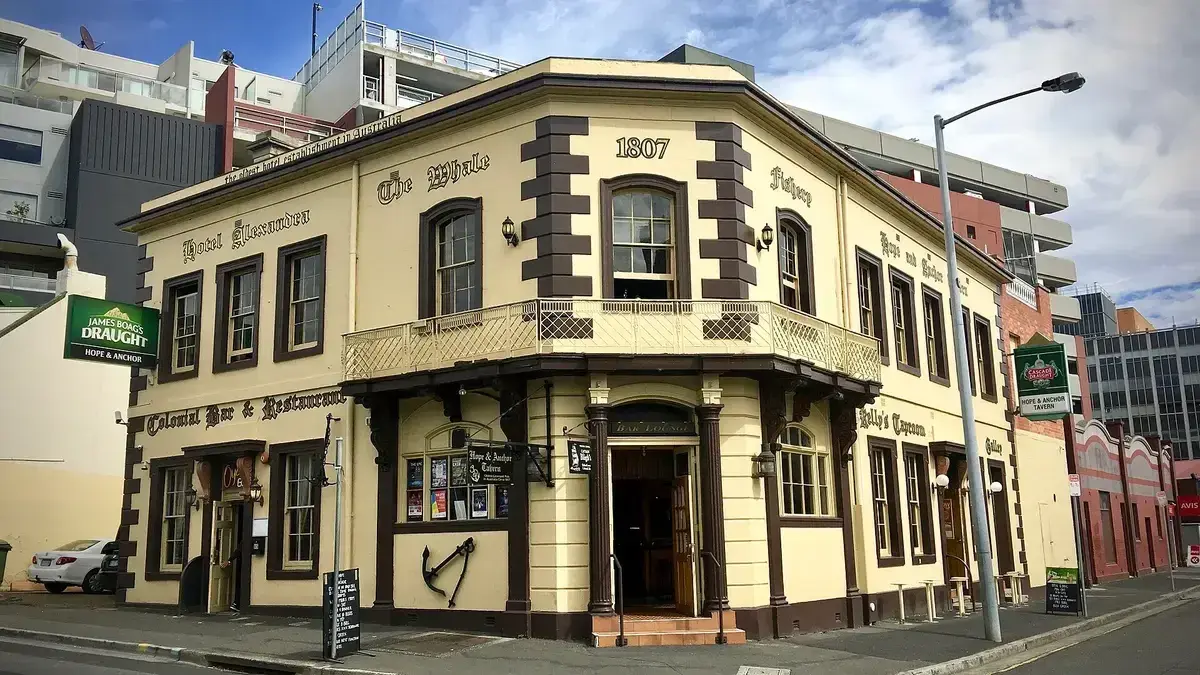

The claim
Australia’s oldest-pub argument is the most enjoyable in the world, partly because it has been running for well over a century and partly because the people conducting it are unusually good humoured about it. Hobart’s Hope and Anchor Tavern dates itself to 1807. The Bush Inn at New Norfolk, upriver on the Derwent, answers with a claim to be continuously licensed since 1825. In New South Wales, Parramatta’s Woolpack Hotel says it was licensed in 1796, when the colony was eight years old, and the Macquarie Arms at Windsor says it opened on a named day: 31 July 1815.
Each claim is doing something slightly different, and once you separate them, the argument turns out to be about definitions rather than dates.
The four side by side
| Pub | Claims | First record | Building | Grade |
|---|---|---|---|---|
| Hope and Anchor TavernHobart | 1807 | 1807 | Early 19th century; enlarged c. 1820 and c. 1840 | Grade B |
| The Bush InnNew Norfolk | 1815 | 1825 | Begun c. 1815; completed April 1825 | Grade B |
| Woolpack HotelParramatta | 1796 | — | The Dictionary of Sydney dates the colonial inn on the south-east corner of George and Marsden streets to 1820 and records it demolished in 1887, the Parramatta court house going up on its site; the hotel was rebuilt in 1889 on the south-west corner, where it trades now | Grade C |
| Macquarie Arms HotelWindsor | 1815 | 1815 | 1815 | Grade A |
Hobart: a clergyman’s diary
The Hope and Anchor’s evidence is a single sentence written by the Reverend Robert Knopwood, the colony’s first chaplain and a diarist of great and useful indiscretion. On 25 July 1807 he recorded: “This day Hopkins opened a Publick House, the Sign of the Whale Fishery…” He went along at eight in the evening and left after eleven.
That is a dated, contemporary, primary record of a public house opening in Hobart, which is more than most Australian pubs can produce. The difficulty is joining it to this building. The pub historian Colin Dennison has questioned whether Knopwood’s entry refers to the Macquarie Street site at all, noting drily that the reverend’s own relationship with ale was not always conducive to precision. Hobart’s early street layout shifted, the Hobart Rivulet has been culverted and built over, and the sign of the Whale Fishery cannot be tied to the standing walls.
The second problem is continuity, and it is the one the pub’s rivals press hardest. The Hope and Anchor was closed to the public for six years, from 2008 to 2014, and also in the 1980s, with the licence kept alive in the meantime. “Continuously licensed” and “continuously trading” are not the same claim, and the difference matters when the title is at stake. Hobart Brewing Co took over the lease in 2025, and the rooms of antiques and maritime relics are open again.
New Norfolk: a claim the newspapers do not support
The Bush Inn’s counter-argument was always continuity rather than antiquity: not the oldest opening date, but the longest unbroken licence, celebrated on a plaque unveiled in 1975 for 150 years of continuous licensing. Construction began around 1815 and the house was finished in April 1825, when Ann Bridger was granted its first spirits licence.
Then the newspapers were checked. The publican-historians at Time Gents found that Alex Smith sold the property in 1873, that the pub appears to have closed in 1874 and become the private residence of Samuel Smith Travers, and that an advertisement in Hobart’s Mercury in 1877 announced its reopening by Octavius Blockley. Three years as somebody’s house is a break in the licence, and it undoes the one claim the Bush Inn was making. What survives is still considerable: a two-storey Georgian inn, trading seven days, where W. Vincent Wallace composed in 1838, Dame Nellie Melba sang in 1924, and Australia’s first trunk telephone call was received in 1888.
New South Wales: the oldest licence and the oldest opening
The Woolpack has the earliest date on the mainland — one of the first ten publican’s licences in the colony, granted in 1796 — and the weakest paper trail. The sources cannot agree on who granted it: some say Governor Hunter, others Governor Phillip, who had sailed for England in 1792 and so cannot have signed anything in Parramatta four years later. The trade journal PubTIC, reviewing the field, concluded the provenance cannot be confirmed. And in the 1890s the business was rebuilt on the opposite side of George Street under a different name, so neither the building nor the site is the one that was licensed. It is a busy, recently renovated CBD hotel with a genuinely long lineage and nothing much to prove it with.
The Macquarie Arms at Windsor is the one contender with an opening date you can put your finger on. Richard Fitzgerald built it at Governor Lachlan Macquarie’s direction, and it opened under Thomas Ranson on 31 July 1815. The convict-era brick building survives on Thompson Square, with Georgian doorways, cedar joinery, a circular staircase and stone-flagged cellars, and it is on the New South Wales State Heritage Register. That is why we grade it A while the others grade B and C.
It also has the largest gap of any of them. From the late 1830s it was the officers’ mess of the 50th Regiment, then a private residence, and it was not relicensed until 1874, trading as the Royal Hotel until 1960. No mainland house has an earlier opening date that a record will carry, and the building it opened in is still there. Oldest continuously licensed: not remotely.
So which is Australia’s oldest pub?
There is no answer that survives all three tests, and PubTIC’s conclusion — that the crown may never be agreed — is the correct one. What can be said:
- Earliest documented opening of a public house still trading on (or very near) the same spot: the Hope and Anchor, on Knopwood’s diary of 25 July 1807, with the site identification unproven.
- Earliest documented opening on the mainland, in a building still in use: the Macquarie Arms, 1815.
- Oldest continuously licensed pub in its original building: on the evidence, neither Tasmanian claimant. Time Gents suggests the Surveyor General Inn at Berrima, licensed in 1835 — though it too was closed from 30 June to 17 October 1895 before being relicensed, which shows how thin the ice is under every version of this claim.
- Earliest claimed licence: the Woolpack, 1796, unconfirmed.
Our methodology sets out why we treat a diary entry, a licence and a datestone as three different kinds of evidence rather than one. You can compare the whole field on our pages for Australia’s oldest pubs, Tasmania and New South Wales, or see where they land against the world in the top 100 oldest pubs.
Sources
Found something wrong?Suggest a correction