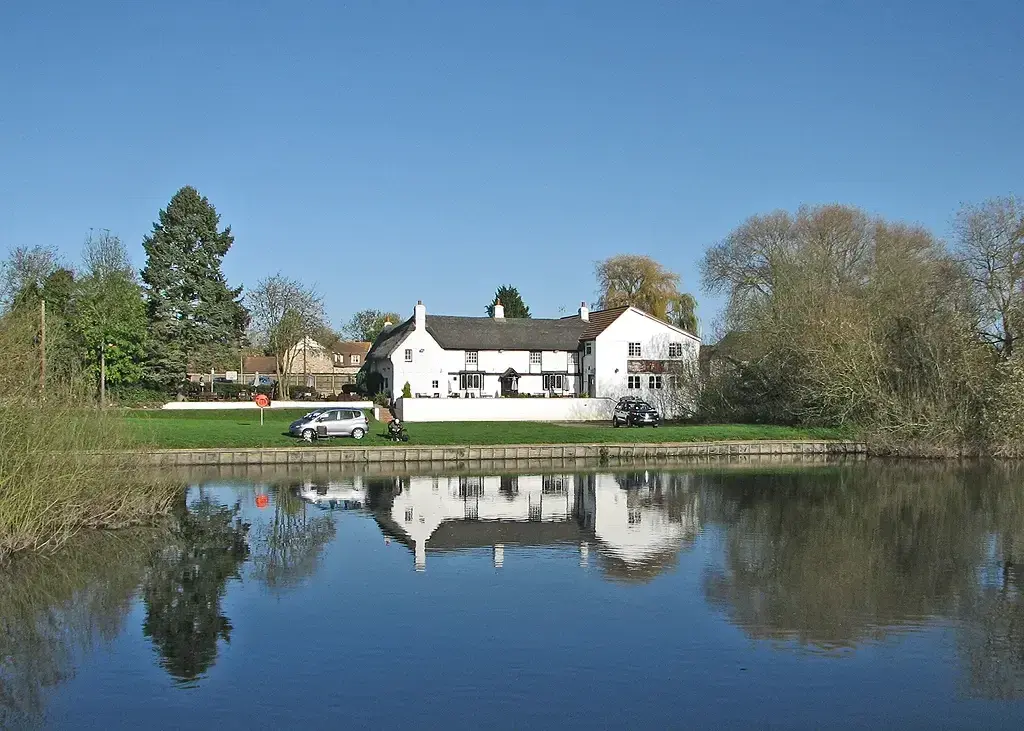

The claim
Of every pub we have researched, one puts an earlier date on itself than any other in the world: AD 560, at a thatched inn at the end of a lane in Holywell, on the bank of the Great Ouse outside St Ives in Cambridgeshire. That makes the Old Ferry Boat Inn the number one entry by claimed date in our top 100 oldest pubs, and it is the reason we publish two answers to every oldest-pub question rather than one.
To its credit, the pub does not shout. The claim sits quietly on the website and in guide listings; it is repeated far more loudly by other people. A blogger who visited in 2019 noted that the staff keep the date low key, probably because visitors keep asking to see the evidence.
Where AD 560 comes from
Nowhere anybody can point to. There is no charter, no court roll, no licence, no map and no excavation report behind the year. Wikipedia’s own citations for the claim are a 2017 listicle and a 2019 regional-news round-up of pubs that call themselves the oldest — which is a fair picture of the sourcing. Trace the date back and it dissolves into repetition.
That is not the same as saying nothing happened here early. The site is a river crossing, and crossings are among the oldest fixed points in any landscape. The village name records a holy well, and local tradition has Hereward the Wake crossing the Ouse at this point during his resistance to the Normans. A ferry ran here into the 1930s, and a photograph from 1892 shows it decorated for the village’s Oak Day. People have needed to get across the water at Holywell for a very long time. Whether one of them was selling ale in the sixth century is a question the sources simply cannot answer.
What the records show
| What | The Old Ferry Boat Inn |
|---|---|
| Claims | AD 560 |
| Earliest named licensee | 1841 census (Thomas Metcalf) |
| Standing building | seventeenth century with an earlier cross-wing |
| Oldest timber | bog oak reported as fourteenth or fifteenth century |
| Listed | Grade II |
| Our grade | C — tradition |
The listing describes a seventeenth-century inn with an earlier cross-wing, and the building contains bog oak reported as fourteenth- or fifteenth-century — bog oak being timber recovered from the peat, which was ordinary fen building material and can be far older than the structure it ends up in. The inn began as two separate dwellings: the Boat, facing the river, and Ferry Cottage, facing west.
The people are better documented than the building. The 1841 census records Thomas Metcalf and his wife Alice, née Christmas, with their daughters Jemima and Mary Ann. By 1851 Alice is listed as a widow and publican. By 1881 the licensee is William Jackson, and the household includes Henry Crane, ferryman. In 1891 Jackson is still there at 73. 1939 brings William Hollis, innkeeper; 1943, Beatty Carter as licensee. That is a continuous, checkable line of publicans running back 185 years, and it is genuinely valuable local history. It is also 1,281 years short of 560.
CAMRA’s entry adds a caution worth knowing before you visit: after a serious fire, much of what you now see, charming as it is, is modern reconstruction.
Juliet Tewsley
The pub’s other story is more famous than its founding date. Set among the dining tables is a dark stone slab said to cover the grave of Juliet Tewsley, a local girl who is supposed to have fallen in love with a woodcutter named Tom Zoul, been rejected, and hanged herself on 17 March 1050, and so been buried in unhallowed ground outside the inn. She is said to walk each year on the anniversary, and staff traditionally avoid stepping on the stone.
There is no eleventh-century record of Juliet Tewsley, and the specificity of the date is itself a warning sign; genuine eleventh-century records of ordinary people rarely give a day and a month. But this is one of the best-loved ghost stories in the eastern counties, the slab is really there, and the tale is told with affection rather than gimmickry. It has earned its place among our haunted pubs, and the pub is no less good for telling it.
So what should the sign say?
Something like: a thatched riverside inn of the seventeenth century, on a crossing used for a thousand years, with licensees recorded continuously since 1841. That is a considerable thing to be, and it is all true.
For comparison, the strongest documented medieval inn still trading in England is the George at Norton St Philip, whose upper floors have been tree-ring dated to 1430–32 and which was purpose-built as an inn by Hinton Priory. That is the difference between a claim and a record, and it is why the George grades A while the Ferry Boat grades C. Our methodology explains how we handle the gap, and you can compare the rest of the country’s contenders on our page for England’s oldest pubs.
Go anyway. Few pubs in England sit better in their landscape: low thatch, lawns running down to the Ouse, and a bar where the ceiling is close enough to touch. Just take AD 560 as part of the scenery, not part of the record.
Sources
Found something wrong?Suggest a correction