
The claim
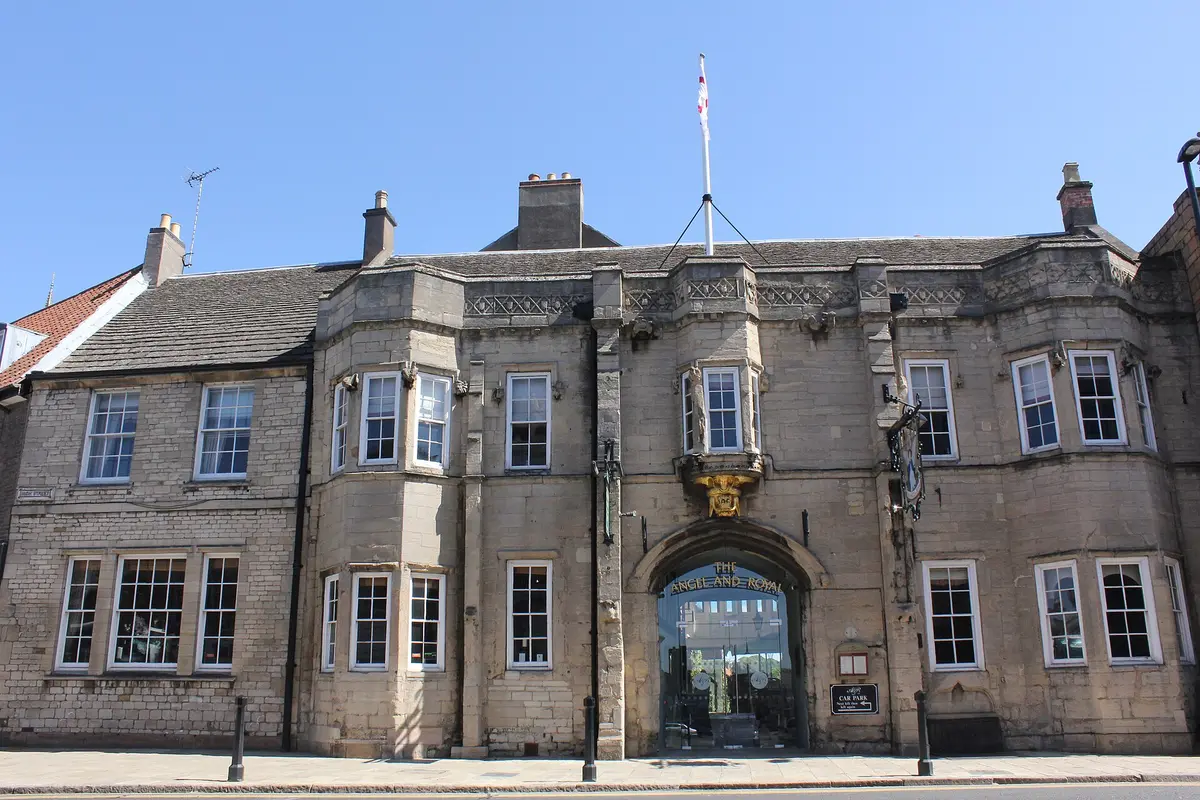
There are only a handful of medieval inn fronts left standing in England, and the finest of them is on Grantham High Street. The Angel and Royal presents a wall of pale oolite ashlar with buttresses, a panelled parapet, an original window and a carriage arch to the yard, and over the arch a demi-angel corbel carrying an oriel window. It is a building that needs no publicity, which makes the publicity it has all the more interesting.
The front page of the hotel’s website carries the words welcoming guests since 1203, and calls the house reputedly England’s oldest inn. Click through to the history page and the tone changes entirely. There, the hotel says the building stands on ground believed to have belonged to the Knights Templar, acquired by the preceptory of Temple Bruer; that tradition holds King John and his court lodged here on 23 February 1213; that the Angel has been known to travellers on the Great North Road for more than 800 years; and — in a sentence very few pubs print about themselves — that there are no records of the Angel and Royal’s exact origins.
Both pages belong to the same hotel. One of them is right.
What the records show
Lincolnshire’s historic environment record is the county’s file on the site, and it is the most useful document in this argument because it describes not an inn but an institution.
What stood here, on its reading, was a camera of the Knights Templar: an estate house of the military order, the administrative centre from which the Templars ran their property in the district, possibly passing to the Knights Hospitaller after the Templars were suppressed in 1308. A camera was not an inn. It housed brothers of the order and their business; it did not sell drink over a counter to whoever walked in off the road. On this site that distinction decides the date, because our methodology dates a house from public, drink-led trade and not from the first roof on the plot.
Nothing we have traced dates a drinking house here to 1203, or to the thirteenth century at all. A history of the Great North Road names Richard Leeming as tenant of the Angel Inn and an alderman of Grantham in 1666, and says the house carried the town’s post from the sixteenth century to the early nineteenth — but it cites no record for either statement, so neither can carry a grade. The Angel is therefore graded C here: not because the building is doubted, which would be absurd, but because no document naming it as an inn has been read.
The building, dated
Historic England lists the house at Grade I, list entry 1062486, and its dating is unambiguous: late fourteenth century. Two storeys, stone, stone slate roof, the medieval street front with its original window, buttresses and panelled parapet, the carriageway on the right with the demi-angel corbel above it supporting an oriel. On the north side of the yard behind, a long range of the late eighteenth century, four storeys of brick with shaped stone arches and keystones over square-headed windows, and two rainwater heads dated 1776. Inside, a vaulted soffit to the ground-floor bay window with a carved boss of a pelican, and an eighteenth-century staircase.
The county record sharpens the date further, and it does it with a detail anyone can check from the pavement. The entrance arch can be no earlier than 1370, because the corbelled heads over it are Edward III and Philippa of Hainault. Philippa died in 1369; a mason does not carve a commemorative pair of royal heads before there is something to commemorate. The west wall is largely fifteenth century.
So the front is a century and three quarters younger than the claimed foundation, and the yard range is Georgian. The gap here is not the usual one between a legend and a building — it is between a legend and an exceptionally well dated building, which is rarer and more awkward.
King John, 23 February 1213
The royal visit is the part of the story most worth handling gently, because it may well be true and it still does not do what it is asked to do.
King John moved constantly, his itinerary is reasonably well reconstructed, and Grantham sits on the road he used. A night in the town in February 1213 is entirely plausible. What the tradition cannot supply is a document saying he slept in this house, and the hotel does not pretend otherwise: it says tradition holds it, which is the correct form of words.
Notice, too, what a royal lodging would prove if it were documented. A king and his court did not stay at inns as a matter of preference; they stayed at castles, religious houses and the residences of great men, and a Templar camera is exactly the third kind of place. A confirmed visit in 1213 would be evidence that this was the order’s house, not that it was a public one. The claim’s two halves work against each other.
Richard III and the Great Seal
The later royal story has the same shape and a firmer footing. On 19 October 1483, Richard III — three months on the throne and facing the Duke of Buckingham’s rebellion — was at Grantham, and the hotel says he received the Great Seal here, which allowed him to begin proceedings against Buckingham. It shows a copy of the letter he wrote in the town.
That letter is real, and the king’s presence in Grantham on the day is not in dispute. The letter does not name the house. The version told in guidebooks, in which Richard signed Buckingham’s death warrant in an upstairs room, is a tidying-up of the record rather than the record — and the hotel’s own account of it is more careful than the guidebooks’. By 1483 this was a substantial fifteenth-century building on the main road north, and it is a reasonable place for a royal party to have stopped. Reasonable is not documented.
So how old is the Angel and Royal?
Fourteenth century in stone, and undated as a drinking house.
The building is one of the two or three finest medieval inn fronts surviving in England, protected at Grade I, dated by the national register to the late fourteenth century and fixed after 1370 by the heads over its arch. Before that there was a Templar estate house on the ground, which is a genuinely remarkable thing for a working hotel bar to sit on top of, and which is not an inn. The first person named here in connection with the Angel is a seventeenth-century alderman, in a book that gives no source.
The 1203 belongs to the front page and not to the archive, and the hotel has already said so in its own words. Anyone may drink in the main bar: the Grantham branch of the Campaign for Real Ale lists it with two handpumps and updated its entry in March 2026, which is why the house is on this site at all. For the rest of the field see the oldest pubs in England, and for the shape this argument takes elsewhere, what does “Ye Olde” actually mean.
Sources
Found something wrong?Suggest a correction