Blog
Why Britain Has So Many Pubs
The answer is not thirst or weather. It is licensing, decided twice: in 1552, when justices of the peace were given the power to say who could keep an alehouse, and in 1830, when Parliament took that power away again and let any ratepayer sell beer for two guineas. Within six months 24,342 people had paid. Every count since has been a subtraction from the number that produced, and our own files show the paper trail starting exactly where the licence does.
Published 28 September 2026

What this establishes
- Of the 152 United Kingdom pubs in our published dataset, only five carry dated evidence from before 1552, the year justices of the peace were first required to license alehouse keepers — and not one of those five pieces of evidence is a licence. They are a taverner in Winchester's local records around 1430, a tree-ring date of 1430–32 at Norton St Philip, a scholarly dating of the fabric at Gloucester, a conveyance of 18 December 1455 at Aylesbury, and a map of Southwark of about 1542. The other forty dated records we hold for British pubs all fall in 1552 or later. We counted this on 29 September 2026 from the file below.oldpubs.com
- The claims and the evidence peak two centuries apart. Among those same 152 pubs the commonest century for a founding claim is the sixteenth, with 39 of them, while the 45 dated records we hold peak in the eighteenth, with 14. The date on a British pub sign tends to sit in the century the licensing paperwork began; the date we can document tends to sit in the century that paperwork survives from.oldpubs.com
- The Red Lion at Southampton claims 1148 for its vaulted cellar, and the earliest date Southampton's local histories give for drinking on the premises is a licence of 1552 — the same year as the Act that created licences for alehouse keepers. The claim is about a cellar and the record is about a licence, which is the shape of almost every British pub claim we hold.oldpubs.com
- Setting two pages of the Webbs' 1903 history of liquor licensing against each other gives the scale of what 1830 did: England and Wales held 51,482 licensed alehouses in 1830 (page 108), and within six months of the Beer Act taking effect on 10 October that year, 24,342 new beer-sellers had paid their two guineas to the excise (page 116). The trade acquired roughly half as many new competitors again in half a year, and the figure kept climbing — 30,978 in 1831, 33,515 in 1832, 45,717 by 1838.archive.org
The answer is not thirst, or weather, or anything flattering about the national character. Britain has a great many pubs because Parliament decided twice how many there ought to be and was wrong both times, in opposite directions. In 1552 it decided there should be fewer, and made the alehouse a licensed trade. In 1830 it decided the licence was the problem, abolished most of it, and had more than 30,000 new beer shops on its hands by the end of the following year. Everything after that — the brewers’ estates, the Beer Orders, the closure figures in the news every January — is the country working through the second decision.
It also explains something we deal with every day on this site, which is why so few old British pubs can prove their age.
1552: the year the records start
The statute is 5 and 6 Edward VI c. 25, and Sidney and Beatrice Webb’s 1903 history of liquor licensing describes what it did in one sentence you can read on page 5: justices of the peace were authorised to select, at their discretion, certain persons in each county or borough who alone were to keep a common alehouse. “From this time forth,” the Webbs write, “the occupation became an exceptional privilege, to which no person could assert a right.”
For a site that dates pubs, 1552 is less a law than a starting gun. Before it, selling ale generated no paperwork at all, and an inn that lodged travellers needed no licence either — the Webbs note that inns were only dragged under the alehouse rules because they sold ale to all comers as well as to their guests. A trade that requires no permission leaves no permissions behind.
So we counted. Of the 152 United Kingdom pubs in our published dataset, five hold dated evidence from earlier than 1552, and not one of the five is a licence. They are the Royal Oak at Winchester, where local historians cite an unnamed taverner on the site around 1430; the George at Norton St Philip, whose timbers are tree-ring dated to 1430–32 and which Historic England regards as probably the earliest surviving purpose-built inn; the New Inn at Gloucester, dated to the mid-fifteenth century by scholarship rather than by any document naming a year; the King’s Head at Aylesbury, named as the newly built Kyngeshede in a conveyance of 18 December 1455; and the George in Southwark, which Historic England’s own writing traces to a map of about 1542. A taverner, some oak, a listing, a deed and a map. The other forty dated records we hold for British pubs fall in 1552 or later, because that is when the state started writing pubs down.
You can watch the two systems meet at the Red Lion in Southampton. The house claims 1148, a date that belongs to the medieval vault under the floor. The earliest year Southampton’s local histories give for anyone selling drink there is 1552 — the year of the Act. The claim is about a cellar; the record is about a licence; both are honest and they are not about the same thing.
The same split runs through the whole file. The commonest century for a British founding claim in our data is the sixteenth, with 39 of the 152, while the dated records peak two centuries later, in the 1700s. The year on the sign tends to come from the century the paperwork started. The year we can show you tends to come from the century the paperwork survives.
1830: two guineas, and the gin problem
By 1830 the licensing system had produced a trade of 51,482 licensed alehouses in England and Wales, up from 47,933 six years earlier, and a political conviction that the magistrates who granted those licences were the reason the beer was bad and the gin was popular.
The remedy is worth stating plainly, because plainly is the funniest way to state it. Parliament’s response to a national anxiety about spirits was to deregulate beer. Moving the second reading of the Beer Bill on 4 May 1830, Mr Calcraft told the Commons that the object was an entire free trade in that article, permitting any person to obtain a licence to sell beer from the excise “on the payment of two guineas”. No character reference, no magistrate, no limit on numbers. A supporter promised the House it would “bring beer into competition with gin — the brewer into competition with the distiller — the beer-shop against the gin-shop”. Mr Portman, opposing, offered the objection that has outlived every argument made that afternoon: it was impossible to regulate the tastes of the people by Acts of Parliament. The House divided 245 to 29 in favour.
The Act came into force on 10 October. Anyone on the rate book could open their front room as a beer shop for two guineas, and the Webbs record what followed on page 116: 800 licences taken out in Liverpool alone within nineteen days, 24,342 nationally within six months, 30,978 by the end of 1831, 45,717 by 1838. The new houses were known, the Webbs note, as “Tom and Jerry shops” or “tiddlywinks”, “for some inexplicable reason”. Set against the 51,482 licensed alehouses the country already had, Parliament had come close to doubling the number of places selling beer in England and Wales inside eight years, without once debating how many places selling beer there ought to be.
It changed its mind, in the way governments do when the mail is heavy, though not at speed. Quarter sessions petitioned, committees sat, and in 1869 the Wine and Beerhouse Act put beerhouses back under the justices — thirty-nine years after taking them out.
That generation of houses is still visible in our data, though not where you would expect. The Old Queen’s Head in Sheffield is a timber-framed house Historic England dates to about 1475 and first recorded in an inventory of 1582; the pub next door opened in 1840 and only spread into the medieval range after 1862. The George & Dragon at Houghton is sold as thirteenth-century and its earliest firm record is 1867. Old buildings, Victorian licences. It is the commonest pattern in our own file and the least advertised anywhere.
Who ended up owning them
The tie was not invented in 1830, but 1830 fed it. An excise return of 1816, quoted by the Webbs on page 91, found that of 48,000 licensed alehouses in England and Wales, 14,200 already belonged to brewers, 10,800 to their occupiers and 22,700 to disinterested persons. Calcraft himself used the brewers as an argument for his Bill: in the country, he said, it was well known that the brewers owned the public houses. Free trade was supposed to loosen that grip.
It did the reverse, at speed, because the two guineas was small enough for a brewer to pay on somebody else’s behalf. Agents went from village to village persuading anyone with a rated cottage to start selling beer, advancing the fee and supplying casks on credit; one firm claimed in 1833 to have opened two hundred beer shops in and around Birmingham. A measure written to break the brewers’ estates handed them a cheap way to enlarge them, and the tied house became the shape of the English pub for the next 150 years.
The intervention people in the trade still argue about came a century and a half later. The Supply of Beer (Tied Estate) Order 1989 gave any brewer holding more than two thousand licensed premises until 1 November 1992 to stop brewing, sell the excess or release half of it from the tie, and from 1 May 1990 required tied tenants to be allowed one guest cask beer of their own choosing. The order was revoked in 2003. What it never said was who should end up holding the premises the brewers were obliged to let go, and that silence has turned out to be the consequential part of it.
And then the long subtraction
The modern numbers are the part everyone knows and nobody agrees on. The Office for National Statistics, answering a freedom of information request, gives a fall from around 50,000 pubs in 2008 to around 39,000 in 2018 — almost a quarter of them gone in a decade — and adds, in the same breath, that its figures run about 10,000 below the British Beer and Pub Association’s because the association counts hotels, inns and restaurants too, and that CAMRA’s volunteers arrived at 47,500 in August 2018 using criteria of their own. The ONS count depends on a business classifying itself under a code that means “public house or bar”.
We went looking for a single series that counts British pubs the same way from 1830 to the present and we could not find one. There is no such thing. Three national bodies produce three numbers today, and the Victorian figures come from excise returns that counted licences rather than houses.
Which is the honest shape of the answer. Britain has so many pubs because a Parliament worried about spirits removed the brake on beer for two guineas a head, and because the estate that grew in the fifty years afterwards was built for a country that walked to work and drank within a few hundred metres of home. Everything since is arithmetic going the other way. The age painted on the sign is usually older than the trade and younger than the walls, and the reason is nearly always a clerk: somebody, at some point, was finally obliged to write the place down.
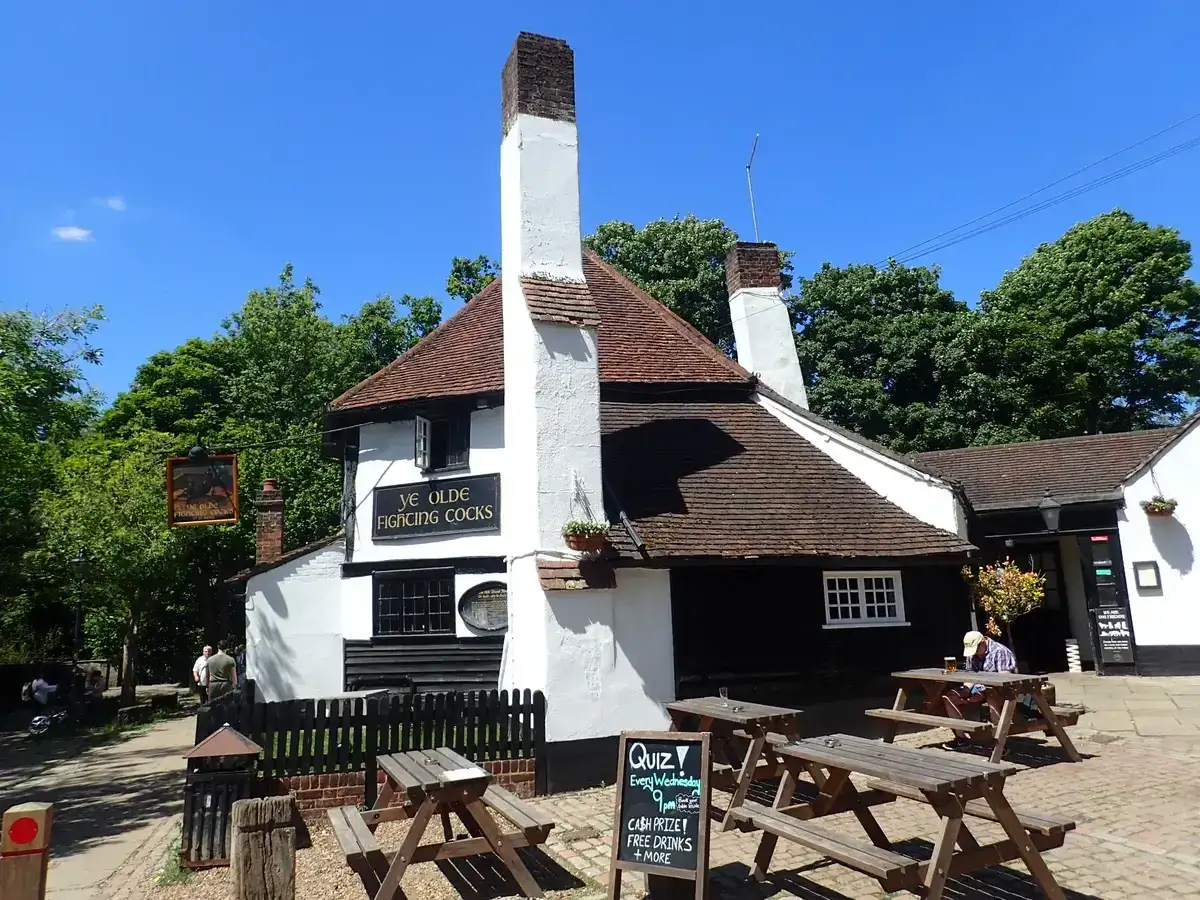
If you want the rule we apply to a claim before it gets a grade, it is on how we date a pub. If you would rather see the claims that did not survive contact with a document, they are in myths, checked, and Ye Olde Fighting Cocks at St Albans is the place to start: 793 on the website, 1756 in the record, and a dovecote underneath it all.
The pubs in this post
- Red Lion Southampton
- The George Inn Norton St Philip
- New Inn Gloucester
- King's Head Aylesbury
- The Royal Oak Winchester
- The George Inn London
- Old Queen's Head Sheffield
- George & Dragon Houghton
- Ye Olde Fighting Cocks St Albans
More in the blog, and every change to the data at what changed.