Blog
The Oldest Pubs in the UK
Britain makes the loudest claims about pub age and holds the youngest evidence for them. Of the 152 British pubs on this site, 107 have no dated record at all behind the year on the sign, and the oldest one that does is traced to 1430 — against a claim of 1002 made by the same house.
Published 28 September 2026

What this establishes
- Of the 152 British pubs with a page on this site, only 45 carry a dated documentary record of any kind behind their founding claim. The other 107 rest on tradition, a datestone, or the house's own account. We counted this on 29 September 2026, and it is the single most useful number we hold about British pub claims.oldpubs.com
- The oldest British pub on this site with a documented record is The Royal Oak at Winchester, traced to about 1430 through records of an unnamed taverner on the site between roughly 1390 and 1430, with a 1637 schedule naming a tapster with a brewhouse. The same house claims 1002, on a legend connecting it to Queen Emma's residence.british-history.ac.uk
- The Cridford Inn at Trusham claims 825 and its earliest record as a pub is 1982, because that is the year it stopped being a farmhouse. CAMRA's South Devon branch and the inn's own history page both say so. The gap of 1,157 years is not a dispute about evidence: both dates are correct and they are measuring different things.camra.org.uk
Britain is very good at old pubs and extremely bad at proving it. Those two facts are related, and the relationship is the most interesting thing about the subject.
We hold 152 British pubs with a page on this site, each with the date it claims and the oldest date anybody can document for it. Of those 152, 45 have a dated record of any kind and 107 do not. That is not an accusation. It is a description of what survives, and understanding why it survives so patchily is most of the answer to the question in the title.
The oldest British pub we can actually show you
It is The Royal Oak at Winchester, and the trail runs to about 1430. Local historians cite records of an unnamed taverner on the site between roughly 1390 and 1430, and a schedule of 1637 naming a tapster with a brewhouse; the Victoria County History for Hampshire carries the background, and you can read that volume yourself.
The Royal Oak claims 1002, on a legend tying the site to Queen Emma’s residence. So even our best-documented British house is running a claim four centuries ahead of its evidence, and it is still the best-documented British house. That should tell you what the rest of the table looks like.
Behind it: The George Inn at Norton St Philip at 1432, New Inn at Gloucester at 1450, and King’s Head at Aylesbury at 1455. All three are magnificent medieval buildings, all three are roughly honest about their dates, and none of them wins the argument in the pub, because the argument in the pub is not conducted in centuries. It is conducted in signs.
Why the records stop where they do
There is a mechanical reason and it is worth knowing before anybody gets indignant.
England had no systematic licensing of alehouses until the sixteenth century. There is simply no national register of drinking houses before then to consult. And Domesday, which is invoked in a startling number of retellings, records no alehouses anywhere — it was a survey of taxable value, not a pub guide.
So for any English pub claiming a date before about 1550, the honest question is not “is this true” but “what could possibly have written it down”. Usually the answer is nothing. A Saxon alehouse keeper did not file anything with anybody. The continental houses do better at this game precisely because they were often abbey or municipal property, and abbeys kept deeds.
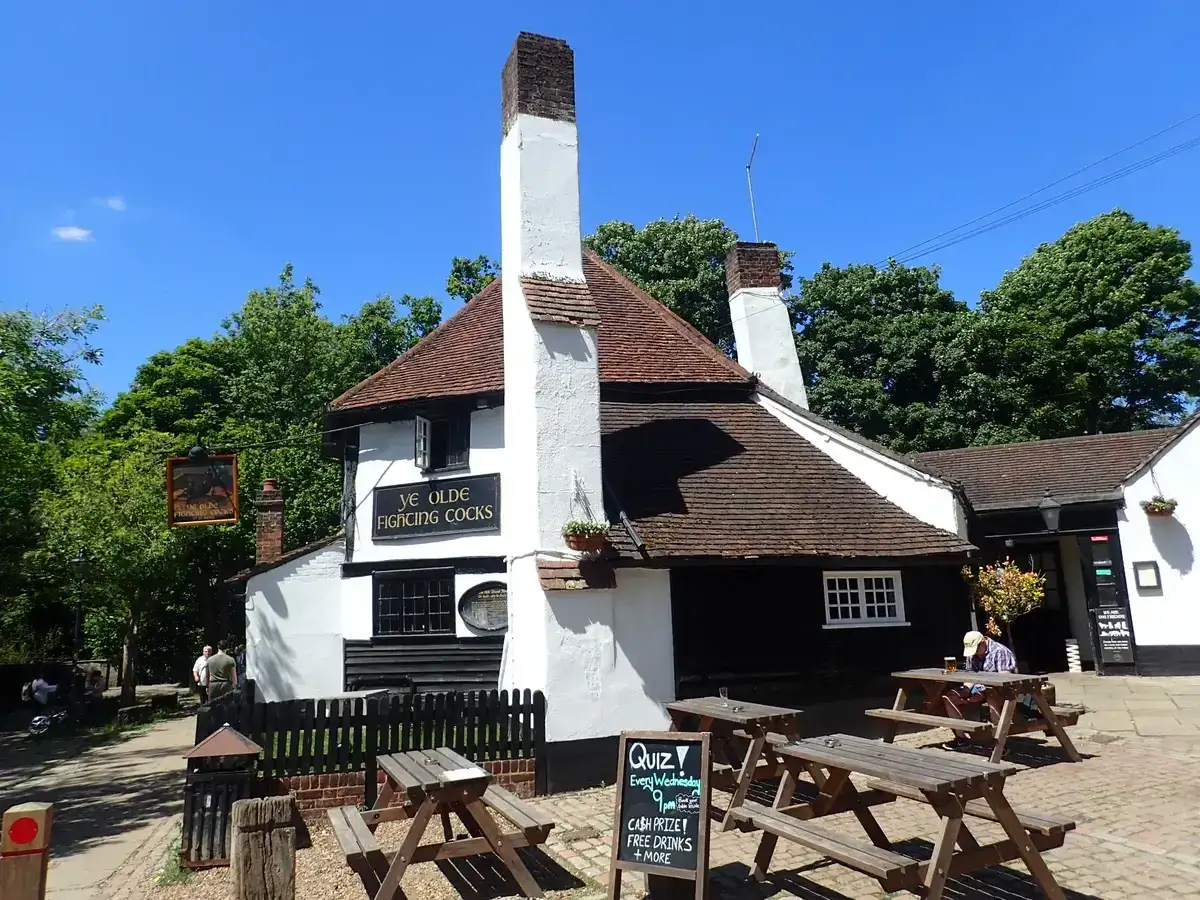
This is why the top of the British claimed table is so thinly evidenced. The Old Ferry Boat Inn claims 560 and its named innkeepers begin in 1841. Ye Olde Fighting Cocks claims 793, a date which — according to Historic England — first turns up on an early-twentieth-century postcard. The Bingley Arms claims 953 against a 1738 datestone. Of the eight loudest British claims, four have no documentary record whatsoever.
The best example on the whole site
The Cridford Inn in Devon claims 825. The earliest record of it being a pub is 1982.
Before you reach for an opinion: both dates are correct. It is a genuinely ancient listed Devon longhouse, the fabric is medieval, and it was a farmhouse until it was converted into a pub and restaurant in August 1982. CAMRA’s South Devon branch says so and the inn’s own history page says so. Nobody is being deceived by anybody.
What has happened is that two different questions have been folded into one number. “How old is this building” and “how long has this been a pub” are separate, and on a sign there is only room for one. That is the entire subject in a single house, and it is why this site records the two dates in separate columns and refuses to average them.
What we could not settle
We went looking for an earlier mention of drink sold at Bardsey — the Bingley Arms’s parish — in the lists that do survive for it. We read a trade directory of 1822, which names a victualler in two of the three places it lists in the parish and none at all in the village, and the poll tax of 1379, which turns out not to cover the village of Bardsey at all. Neither gets us to 953, and neither disproves it. That is usually how this ends: not a triumphant unmasking, but a shelf of records that were never asked to contain the answer.
We have said so on the page rather than rounding it into a verdict. An absence of evidence is only a finding once you have said which records you searched.
So what should you tell people in the pub?
Something like this. Britain has an extraordinary stock of very old buildings that sell beer. The question of which has sold beer longest is probably unanswerable, because the paperwork that would settle it was never created. The houses making the boldest claims are, almost by definition, the ones with the least evidence, because a claim nobody can check is the only kind that can win an unwinnable contest.
And then, if you want to be insufferable about it: which house can actually document the earliest date? On our reading of 351 of them, a Swiss one from 1259, which has never entered the competition at all.
Every grade, every date and every source is in the claims report, including the ones where our own verdict is unflattering to a pub we like. If you have a document that moves any of these, tell us what it says — we have changed our own mind twice this month.
The pubs in this post
- The Royal Oak Winchester
- The Old Ferry Boat Inn Holywell
- Ye Olde Fighting Cocks St Albans
- The Bingley Arms Bardsey
- The Cridford Inn Trusham
- The George Inn Norton St Philip
- King's Head Aylesbury
More in the blog, and every change to the data at what changed.